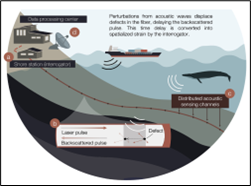
A significant technical milestone has been achieved for the LOWNOISER project with the successful installation and commissioning of a Distributed Acoustic Sensing (DAS) system at the Capo Passero deep-sea research site in southern Italy.
As global attention to the impact of underwater radiated noise (URN) intensifies, the LOWNOISER project—co-funded by the Horizon Europe programme — continues to make progress in developing and validating technologies and methodologies aimed at mitigating URN from ships. One of the key monitoring tools integrated into the project is a Distributed Acoustic Sensing (DAS) system, now successfully deployed and commissioned at the Capo Passero (Sicily) infrastructure operated by INFN-LNS.
The DAS installation fulfills a key milestone in the project, marking the transition from preparatory design and configuration to operational readiness. DAS technology turns fibre-optic cables on the seafloor into thousands of a dense array of virtual hydrophones.
This allows researchers to “listen” to the underwater soundscape over vast distances without deploying any new equipment in the water. In the LOWNOISER project, this technology is being used to monitor Underwater Radiated Noise (URN) from ships and its potential impact on marine life.
The DAS Recorder used in the project :
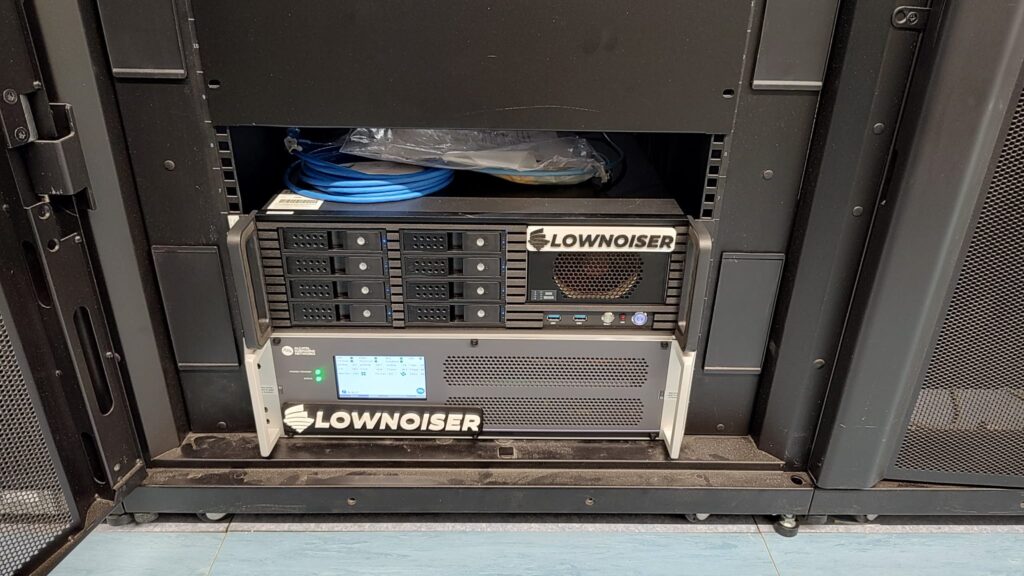
Collects Vital Data on Underwater Radiated Noise
Following successful commissioning, the DAS system has already begun to return useful data. Initial observations have identified clear patterns of anthropogenic noise, consistent with emission of continuous sounds from a closeby ship. These early results confirm the system’s sensitivity and reinforce its potential as a long-term URN monitoring platform.
The next step is to collect data for further analyses including signal classification, source identification, and URN propagation modelling.
The deployment of this system aligns with LOWNOISER’s broader goal: to support the development of data-driven policies and engineering solutions that reduce the acoustic footprint of maritime transport.
By enabling continuous, passive acoustic monitoring in a key vulnerable area, the DAS system provides both a technological benchmark and a scalable approach to addressing one of the most complex and under-recognised environmental challenges facing today’s oceans.