
The LOWNOISER project is making it easier to develop and validate simulation methods for ship cavitation and underwater radiated noise. A new open test case based on the VTT Arctic Thruster gives researchers and industry access to high-quality benchmark data for one of the most complex noise sources in ship propulsion.
One of LOWNOISER’s key objectives is to improve numerical methods for predicting cavitation and noise from full-scale ship demonstrations. To do this reliably, researchers need robust validation data. While several open benchmark cases already exist for ship hulls, comparable open data for thruster propulsors has so far been limited.
A demanding test case for cavitation and noise simulations
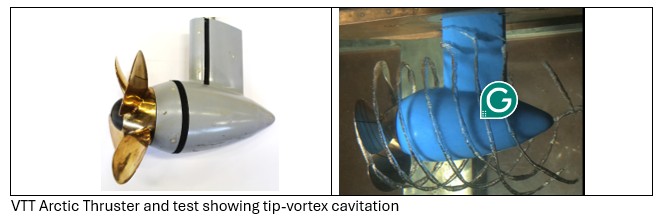
The VTT Arctic Thruster is an unconventional ice-class pulling thruster developed as a benchmark for validating numerical methods. Over several years, VTT has carried out extensive towing-tank campaigns, including open-water measurements of the propeller, thruster housing and complete thruster unit.
More recently, cavitation-tunnel tests have been conducted to verify non-cavitating performance and examine the thruster’s cavitation characteristics. Together, these experiments provide valuable validation data for multiphase CFD and underwater radiated noise simulations.
Freely available as an OpenFOAM tutorial
Within LOWNOISER’s work on numerical method development, the VTT Arctic Thruster has been selected as a dedicated test case for developing and evaluating cavitation and underwater radiated noise simulation methods.
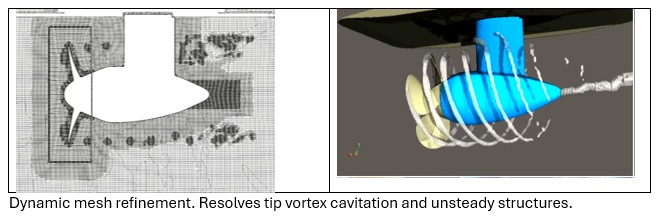
The test case is freely available as an OpenFOAM tutorial, enabling users to simulate noise from several cavitation mechanisms. These include sheet and bubbly cavitation on the blades, different forms of tip-vortex cavitation, and cavitation on the thruster housing.
Supporting quieter and more sustainable shipping
By improving the understanding of cavitation and noise, the work supports more accurate estimates of ships’ underwater radiated noise. This is important both for maritime industry needs and for reducing pressure on marine ecosystems.